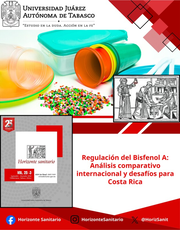
Bisphenol A Regulation: An International Comparative Analysis and Challenges for Costa Rica
DOI:
https://doi.org/10.19136/hs.a25.3.6321Abstract
Objective: To describe national and international regulations governing the use of Bisphenol A (BPA) in food-contact materials and to select four countries based on defined inclusion criteria to compare their regulations with those currently in force in Costa Rica, with the aim of identifying opportunities for improvement in Costa Rica’s regulatory framework.
Materials and methods: A qualitative documentary study was conducted by reviewing international regulations on the use of BPA in food-contact materials and by comparing the official regulations of France, Canada, the United States, Paraguay, and Costa Rica from a neo-corporatist and public health perspective.
Results: 21 countries with current regulations or official measures related to BPA were identified. 76,2 % of these regulations implemented partial bans on BPA. 85,7 % of the regulatory authorities were national health authorities. France and Canada have greater institutionalization and stakeholder participation. Costa Rica maintains regulations limited to packaging intended for children under 18 months, with little stakeholder participation, and no systems for policy monitoring or follow-up were identified.
Conclusions: The regulations implemented in different countries vary in terms of their regulatory scope, governance mechanisms, and elements of the neo-corporatist approach. These findings suggest that strengthening BPA regulation, monitoring, and surveillance in Costa Rica could reduce public exposure to BPA and protect public and environmental health.
Keywords: BPA; Endocrine disruptors; Food packaging; Food legislation.
Downloads
Downloads
Published
Issue
Section
License
Copyright (c) 2026 Horizonte Sanitario

This work is licensed under a Creative Commons Attribution-NonCommercial-ShareAlike 4.0 International License.