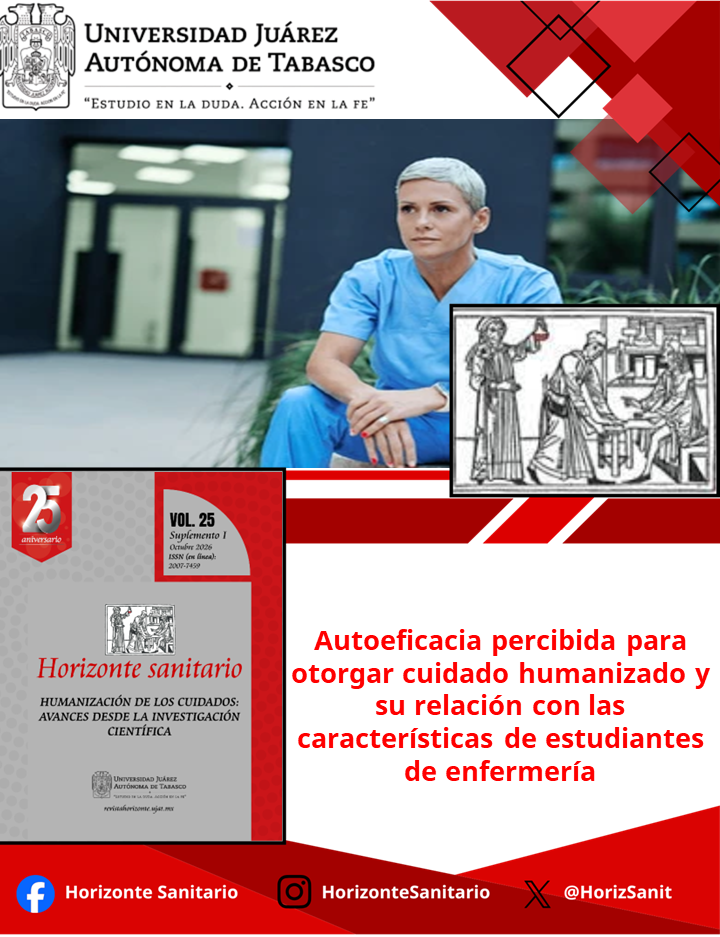
Perceived self-efficacy in providing humanized care and its relationship to the characteristics of nursing students
DOI:
https://doi.org/10.19136/hs.a25.sI.6404Abstract
Objective: To identify nursing students perceived self-efficacy to provide humanized care and relationship with their sociodemographic and academic characteristics.
Materials and methods: A quantitative, descriptive, cross-sectional study with a correlational design was conducted in Tabasco, Mexico, involving 192 nursing students selected through stratified sampling with proportional allocation.The Spanish version of the Caring Efficacy Scale was administered (α= .76). Descriptive and nonparametric statistical analyses were used (Spearman’s correlation, Kruskal-Wallis H test, Mann-Whitney U test).
Results: 61.5% of students showed a regular level of perceived self-efficacy to provide humanized care and 38.5% a high level. A significant inverse association was reported between the empathy dimension and the number of clinical rotations completed (rs= -.191, p= .008), as well as significant differences by semester (H= 6.26, df= 2, p= .044).
Conclusions: Perceived nursing students' self-efficacy to provide humanized care was preponderantly moderate, a smaller proportion reported a high perception, and no cases of a low perception were identified. Humanized care must be comprehended as a complex professional competence built through the interaction between knowledge, technical skills, emotional competencies, values and contextual factors.
Keywords: Humanization of Assistance; Students, Nursing; Education, Nursing; Self Efficacy; Empathy.
Downloads
Downloads
Published
Issue
Section
License
Copyright (c) 2026 Horizonte Sanitario

This work is licensed under a Creative Commons Attribution-NonCommercial-ShareAlike 4.0 International License.