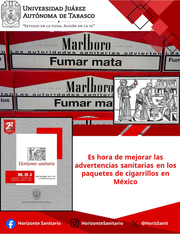
It is time to improve cigarette package health warning labels in Mexico
Effectiveness of messages promoting smoking cessation
DOI:
https://doi.org/10.19136/hs.a25n3.6338Abstract
Mexico has been a leader in tobacco control; however, 15.5% of Mexican adults still smoke, and although most wish to quit, nicotine dependence and the tobacco industry’s constant innovations make this difficult. Health warnings with images on cigarette packets have succeeded in raising awareness of the harms of tobacco and encouraging cessation behaviours, but information on risks alone is insufficient to help smokers quit.
Against this backdrop, it is proposed to strengthen Mexico’s labelling policy by incorporating ‘efficacy messages’ that highlight the benefits of quitting smoking and offer practical advice on how to do so. Health communication theories and empirical evidence indicate that these messages complement risk-based warnings, helping smokers to turn motivation into concrete action.
The experience of Canada (the only country with an established policy of efficacy messages inside cigarette packets) shows that those who read them have greater self-efficacy to quit smoking, make more attempts to quit, and maintain abstinence more successfully. Experimental studies also confirm that these messages increase motivation and behaviours aimed at quitting smoking.
For Mexico, this strategy represents a scalable, low-cost opportunity that can be implemented through inserts in cigarette packets or within the text area already required on packaging, with the potential to reduce the health inequalities associated with smoking and lessen its burden of disease.
Keywords: tobacco control; smoking cessation; drug labeling; health communication
Downloads
Downloads
Published
Issue
Section
License
Copyright (c) 2026 Horizonte Sanitario

This work is licensed under a Creative Commons Attribution-NonCommercial-ShareAlike 4.0 International License.