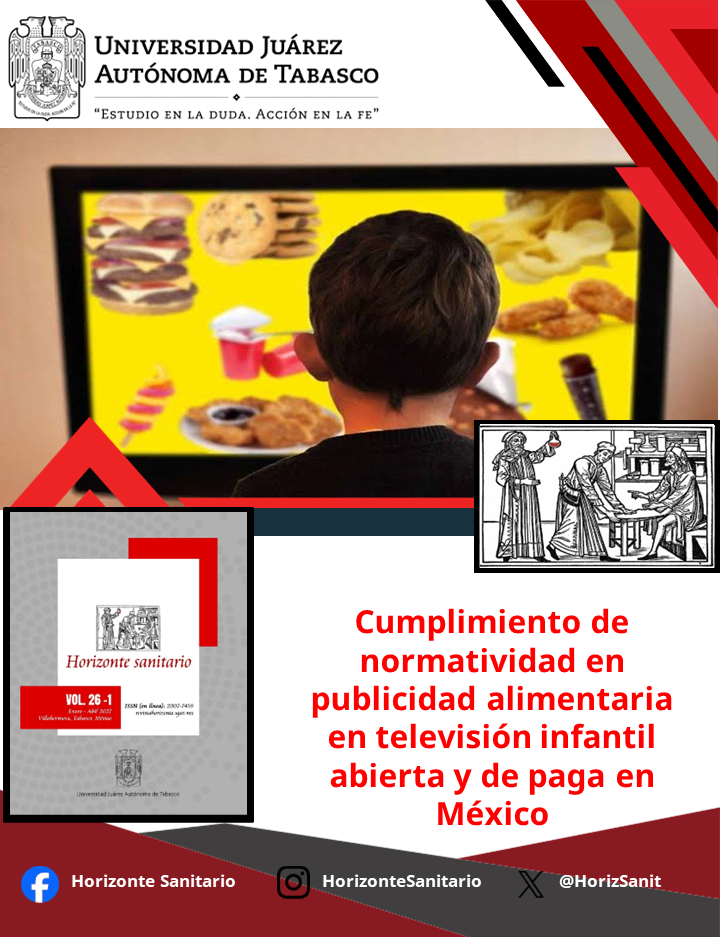
Compliance with regulations governing food advertising broadcast on free-to-air and pay-TV children's channels in Mexico: An observational study
DOI:
https://doi.org/10.19136/hs.a26n1.6297Abstract
Objective: To evaluate the degree of compliance with NOM 051-SCFI/SSAI-2010, the Self-Regulatory Code for Foods and Non-Alcoholic Beverages Targeted at Children (PABI), and the guidelines for food and beverage advertising on television and in movies—specifically regarding unhealthy foods and beverages—using comparative indicators between free-to-air television and pay television.
Material and methods: An observational, descriptive, cross-sectional, and quantitative study was conducted to record commercials for unhealthy foods and beverages broadcast on free-to-air television (Channel 5—Televisa and Channel 7—TV Azteca) and pay TV (Disney and Cartoon Network) from November 16 to 23, 2025, during morning and afternoon time slots.
Results: A total of n=63 commercials were observed on free-to-air and pay-TV channels; the afternoon time slot had the highest frequency of these commercials (n=45). The types of foods and beverages with the greatest visibility are and derivatives, fast food, sugary beverages, soft drinks, sweets, and candies. Regarding NOM 051 and the presence of warning labels, 35 commercials did contain them and they were visible; regarding the use of precautionary statements, 44 of them did contain them. Under the PABI Code, 14 commercials use celebrities and characters, 49 do not use them and 18 use offers or prizes.
Conclusion: Despite the existence of regulations in Mexico governing commercials that promote unhealthy foods and beverages, food companies use children’s television channels as a high-impact method of persuasion, thereby contravening the spirit of current regulations designed to protect children’s health.
Keywords: Food; Food Publicity; Television.
Downloads
Downloads
Published
Issue
Section
License
Copyright (c) 2026 Horizonte Sanitario

This work is licensed under a Creative Commons Attribution-NonCommercial-ShareAlike 4.0 International License.