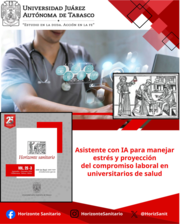
AI-powered assistant to manage stress and work commitment projection among healthcare students
DOI:
https://doi.org/10.19136/hs.a25n3.6248Abstract
Objective: To determine the relationship between AI-powered assistant´s perspective on stress management and work commitment projection of final-term university students in the healthcare field.
Materials and Methods: Quantitative, non-experimental, cross-sectional study. Ninety final-term university students from a Peruvian university were selected through a non-probabilistic sampling. The instrument was a 3-point Likert scale questionnaire with eight items organized into two variables: the AI-powered assistant perspective for the academic stress reduction and work commitment projection. Content validity was estimated with Aiken's V method = 0.96 and reliability with Cronbach's alpha coefficient = 0.88. Analysis included descriptive statistics and Spearman's correlation.
Results: Between 70% and 73.3% of students reported that the AI assistant increased confidence in handling complex clinical situations and reducing the fear of making mistakes during supervised practice. In addition, 60% to 63.3% reported lower anxiety and cognitive overload. 76.7% expressed greater motivation to work in environments with technological support. A significant positive correlation was found between perceived support from the AI assistant and projected work commitment (rho = 0.63; p < 0.005).
Conclusions: The AI assistant has been consolidated as an academic and emotional support tool that helps with stress management and strengthens work commitment projection among university students in the healthcare field.
Keywords: Occupational Stress; Digital health; Healthcare Occupations Students.
Downloads
Downloads
Published
Issue
Section
License
Copyright (c) 2026 Horizonte Sanitario

This work is licensed under a Creative Commons Attribution-NonCommercial-ShareAlike 4.0 International License.